
This project demonstrates a real-time open-source deformable tire simulation engine implemented in TypeScript, using an adaptation of the Extended Position-Based Dynamics (XPBD) method. The formulation follows the model introduced by Macklin, Müller, and Chentanez (2016) in their paper “XPBD: Position-Based Simulation of Compliant Constrained Dynamics.”
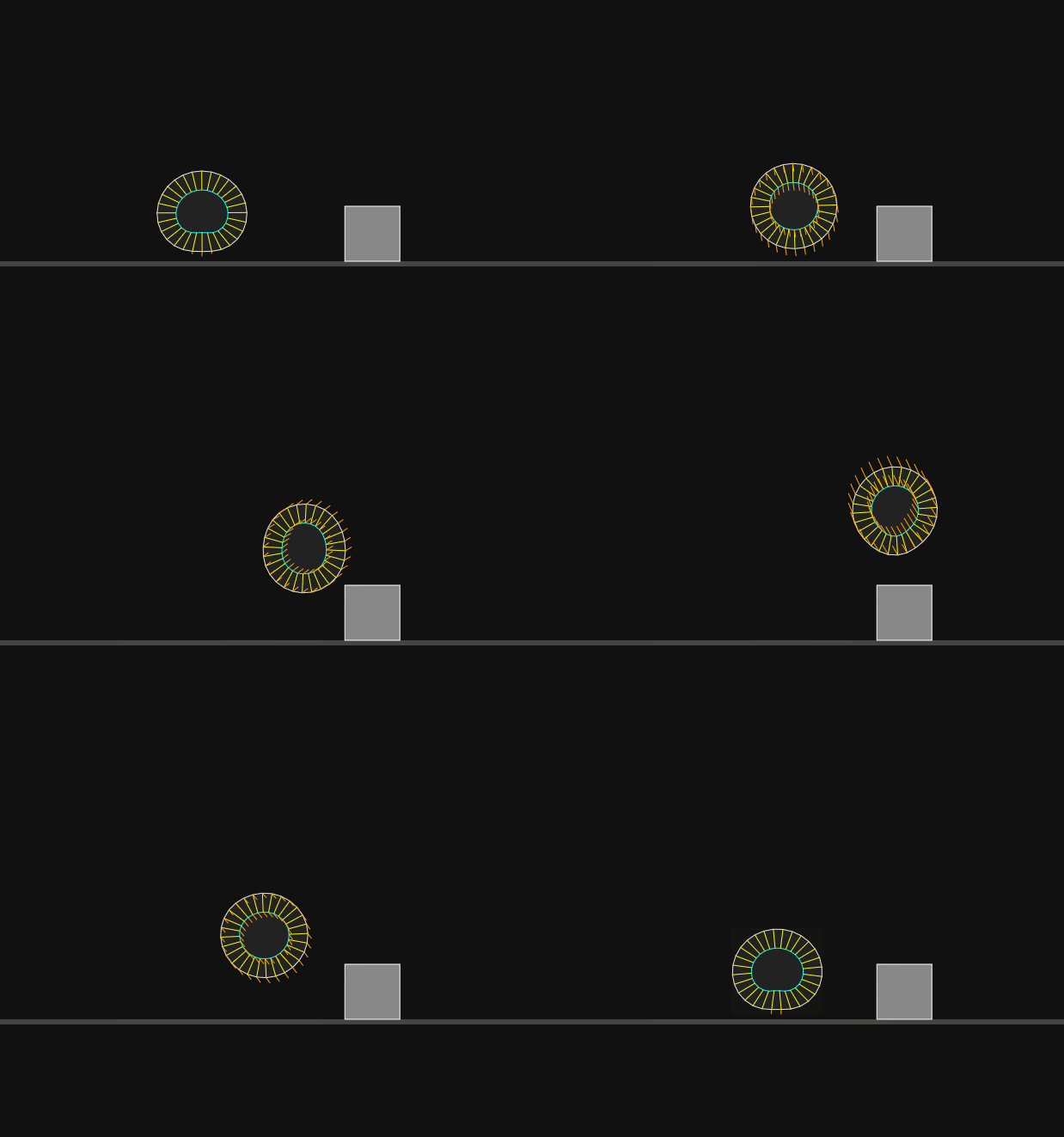
The simulation models a soft-body, air-filled tire composed of discretized particles linked by distance constraints and a global pressure constraint. A full dynamic interaction model is included, featuring:
- adjustable constraint stiffness (outer ring, inner ring, spokes)
- adjustable mass scaling
- steering impulses applied tangentially around the wheel
- exact AABB ground and obstacle collisions
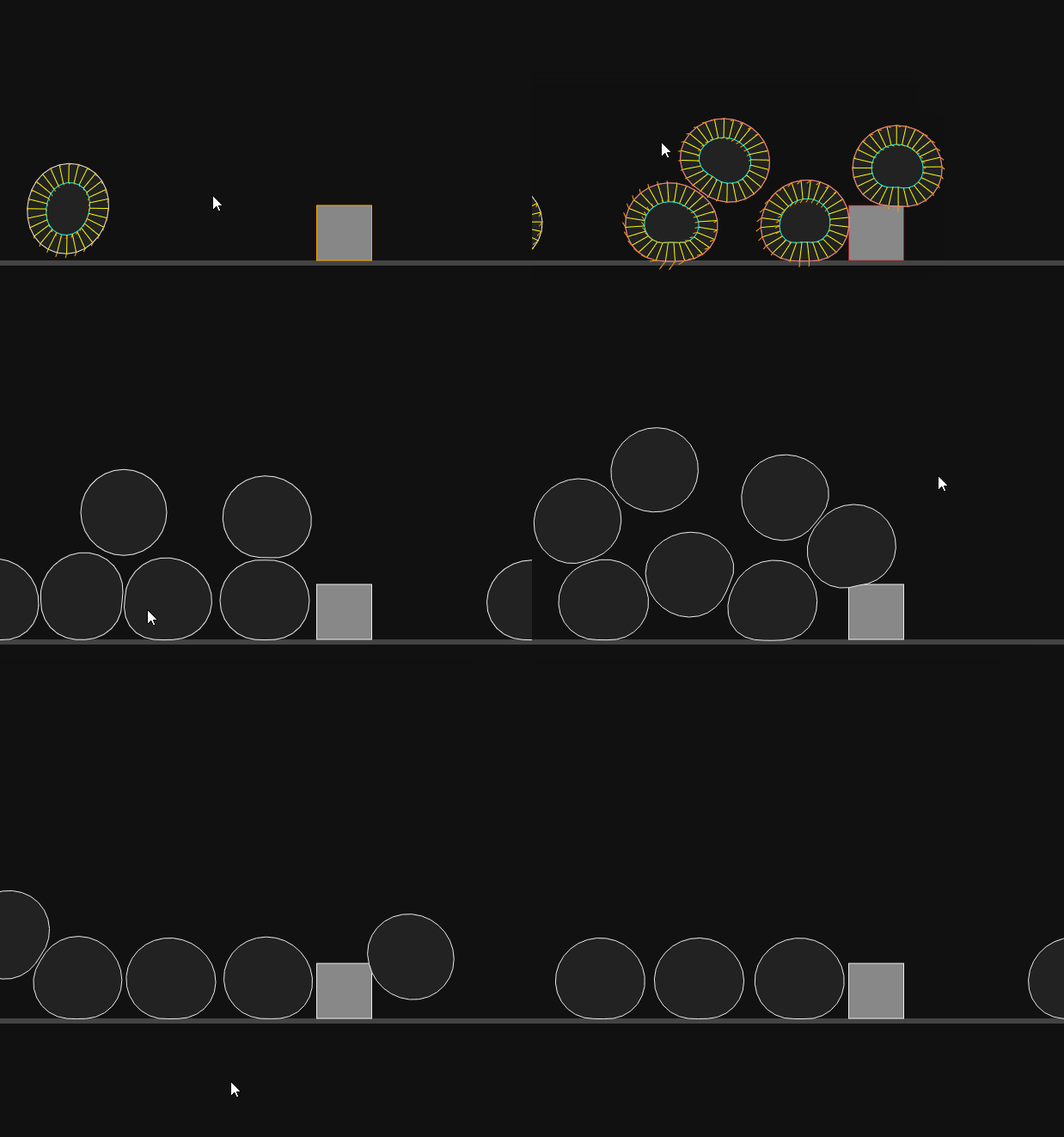
- optional soft–soft particle contacts between tires
- anti-tunneling velocity clamping
- per-particle grounded detection and jumping
- real-time spawning of additional tires
These features make the simulation significantly more expressive than a minimal XPBD prototype, while remaining compact and easy to understand.
Soft to Rigid:
Soft to Soft:
Try out the demo here.
Overview
The tire model consists of two concentric rings of particles.
Each ring contains the same number of particles.
The structure is held together by:
- distance constraints along the outer ring
- distance constraints along the inner ring
- radial constraints linking each inner particle to its corresponding outer particle
- a pressure constraint preserving the enclosed polygon area
A steering impulse system applies tangential velocity around the circumference.
Particles can detect ground contact precisely, enabling a controllable jump impulse.
Runtime UI sliders modify constraint stiffness, pressure, mass scaling, gravity, damping, and solver iterations.
The solver uses XPBD to produce stable behavior across a wide range of stiffness values.
XPBD Background
The XPBD formulation begins with a holonomic constraint:
\[C(x) = 0\]XPBD updates positions through the correction:
\[x^{t+1} = x + \Delta x\]The correction for particle index (i) is given by:
\[\Delta x_i = -\frac{ w_i \nabla C_i }{ \sum_j w_j \|\nabla C_j\|^2 + \alpha / \Delta t^2 } \left( C(x) + \alpha \lambda^{*} \right)\]The quantities used above are:
Inverse mass:
\[w_i\]Constraint compliance (inverse stiffness):
\[\alpha\]Previous Lagrange multiplier:
\[\lambda^{*}\]Simulation timestep:
\[\Delta t\]The compliance value determines the effective stiffness:
\[\alpha = \text{constraint compliance (inverse stiffness)}\]A small compliance approaches rigid behavior, while larger values produce softer elastic responses.
Distance Constraint
Consider two particles with a rest distance defined by the following constraint:
\[C(x) = \|x_b - x_a\| - L_0\]The gradient of this constraint is:
\[\nabla C = \frac{x_b - x_a}{\|x_b - x_a\|}\]The XPBD solver applies the following corrections.
For particle (a):
\[\Delta x_a = -w_a \lambda \nabla C\]For particle (b):
\[\Delta x_b = +w_b \lambda \nabla C\]Distance constraints are used for:
- the outer ring
- the inner ring
- the radial spokes
Pressure Constraint
The enclosed polygonal area of the outer ring is computed as:
\[A = \frac{1}{2} \sum_{i=1}^{N} \left( x_i y_{i+1} - x_{i+1} y_i \right)\]The constraint enforcing area preservation is:
\[C(x) = A - A_0\]The gradient of the polygon area with respect to vertex index (i) is:
\[\nabla_{x_i} C = \frac{1}{2} \begin{pmatrix} y_{i+1} - y_{i-1} \\ x_{i-1} - x_{i+1} \end{pmatrix}\]This constraint behaves like internal pneumatic pressure, keeping the tire inflated.
Contact Resolution (AABB Model)
A simple AABB collision model is used for ground and obstacle interaction.
Penetration is corrected along the minimal-overlap axis.
For a particle with penetration depth (d) and collision normal (n):
After solving all constraints, velocities are reconstructed using:
\[v = \frac{x^{t+1} - x^{t}} {\Delta t}\]This produces stable contact without impulses or friction.
Soft–Soft Contacts
When multiple tires are spawned, short-range soft contacts are created between outer particles belonging to different tires.
These contacts act as minimum-separation constraints.
They prevent tires from collapsing into one another and produce realistic soft-body interaction.
Anti-Tunneling Velocity Clamp
To prevent particles from crossing thin terrain features or destabilizing constraints, velocity is clamped to a maximum allowed magnitude based on timestep and expected segment length.
This ensures stability even under very high forces.
Steering, Movement, and Jumping
Steering:
Tangential impulses are applied around the rim by rotating the hub-to-particle vector.
This creates a rolling motion without explicit rotation or rigid-body mechanics.
Jumping:
A uniform impulse is applied when any outer particle is detected touching the ground.
Horizontal Speed Limit:
Horizontal velocity is capped per particle to prevent runaway acceleration and instability.
Cite This Project
If you use or modify this work in an academic or research context, please cite both this implementation and the original XPBD paper.
@misc{turner2025xpbdtire, author = {Turner, Jakob}, title = {XPBPhysicsPrototype}, year = {2025}, howpublished = {\url{https://github.com/JakeTurner616/XPBPhysicsPrototype}}, note = {Real-time deformable tire simulation based on XPBD} }
@article{macklin2016xpbd, title = {XPBD: Position-Based Simulation of Compliant Constrained Dynamics}, author = {Macklin, Miles and Müller, Matthias and Chentanez, Nuttapong}, journal = {NVIDIA Research}, year = {2016}, url = {https://matthias-research.github.io/pages/publications/XPBD.pdf} }
License
If you use or modify the source code and plan to re-release it, it must be open source under the terms of the GNU GPL 3.0 license.